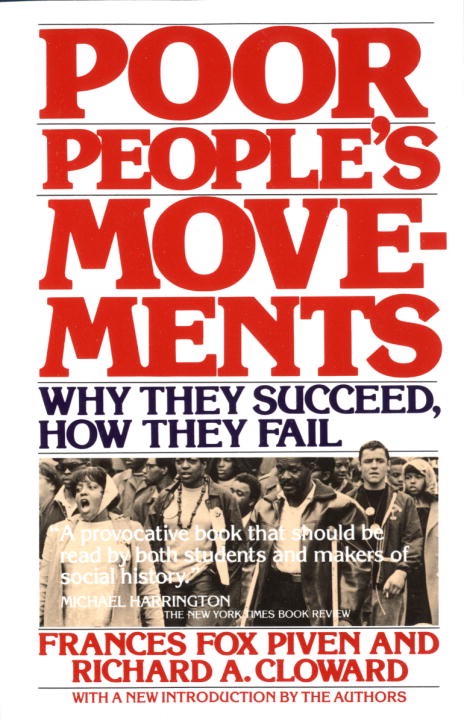
a book
Poor People's Movements
Frances Fox Piven · 1978 · 416 pages
Have the poor fared best by participating in conventional electoral politics or by engaging in mass defiance and disruption? The authors of the classic Regulating The Poor assess the successes and failures of these two strategies as they examine, in this provocative study, four protest movements of lower-class groups in 20th century America:
-- The mobilization of the unemployed during the Great Depression that gave rise to the Workers' Alliance of America
-- The industrial strikes that resulted in the formation of the CIO
-- The Southern Civil Rights Movement
-- The movement of welfare recipients led by the National Welfare Rights Organization.
-- The mobilization of the unemployed during the Great Depression that gave rise to the Workers' Alliance of America
-- The industrial strikes that resulted in the formation of the CIO
-- The Southern Civil Rights Movement
-- The movement of welfare recipients led by the National Welfare Rights Organization.


recommended by 2 people
sourced from public statements

Natalie Shure
“Frances Fox Piven's book Poor People's Movements: Why They Succeed, How They Fail taught me so much about transformative political moments, and this was a really great and thoughtful interview”↗

Angus Johnston
“@AlyssaRosenberg @arncj32 Piven and Cloward are great on this, and a big touchstone for a lot of activists today. Their book "Poor People's Movements" is 40 years old, but it remains crucial reading.”↗