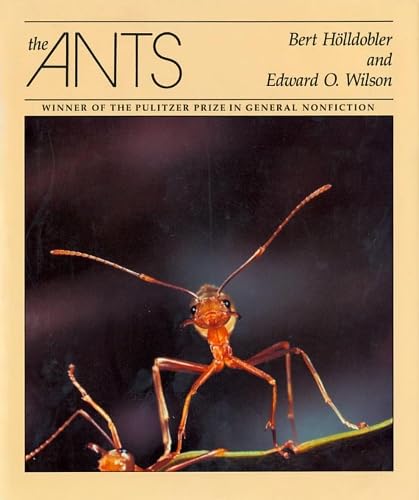
a book
The Ants
Bert Hölldobler and Edward O. Wilson · 1990 · 784 pages
From the Arctic to South Africa - one finds them everywhere: Ants. Making up nearly 15% of the entire terrestrial animal biomass, ants are impressive not only in quantitative terms, they also fascinate by their highly organized and complex social system. Their caste system, the division of labor, the origin of altruistic behavior and the complex forms of chemical communication makes them the most interesting group of social organisms and the main subject for sociobiologists. Not least is their ecological importance: Ants are the premier soil turners, channelers of energy and dominatrices of the insect fauna. TOC:The importance of ants.- Classification and origins.- The colony life cycle.- Altruism and the origin of the worker caste.- Colony odor and kin recognition.- Queen numbers and domination.- Communication.- Caste and division of labor.- Social homeostasis and flexibility.- Foraging and territorial strategies.- The organization of species communities.- Symbioses among ant species.- Symbioses with other animals.- Interaction with plants.- The specialized predators.- The army ants.- The fungus growers.- The harvesters.- The weaver ants.- Collecting and culturing ants.- Glossary.- Bibliography.- Index.


recommended by 2 people
sourced from public statements

Simon Schama
“The Ants (1990) is an astonishing book; absolutely gripping and confounding - however much you think that entomology isnt your thing, it will be,, I promise. It's a huge book about amazing creatures. And Ed Wilson was a lovely committee colleague at Harvard when I was there.”↗

Will Wright
“SimAnt was very much inspired by the work of Edward O. Wilson, very famous myrmecologist, studies ants. He wrote this great book, won the Pulitzer Prize, called The Ants. But he actually, in some sense, was reverse engineering the way ants work. Little ants are almost like little robots, and it’s pretty simple to figure out in the presence of this pheromone the ant does that, in the presence of that pheromone he does this. He actually reverse engineered that and discovered a whole level of emergence.”↗